Replacing & Restoring Teeth
Dental Implant Restorations
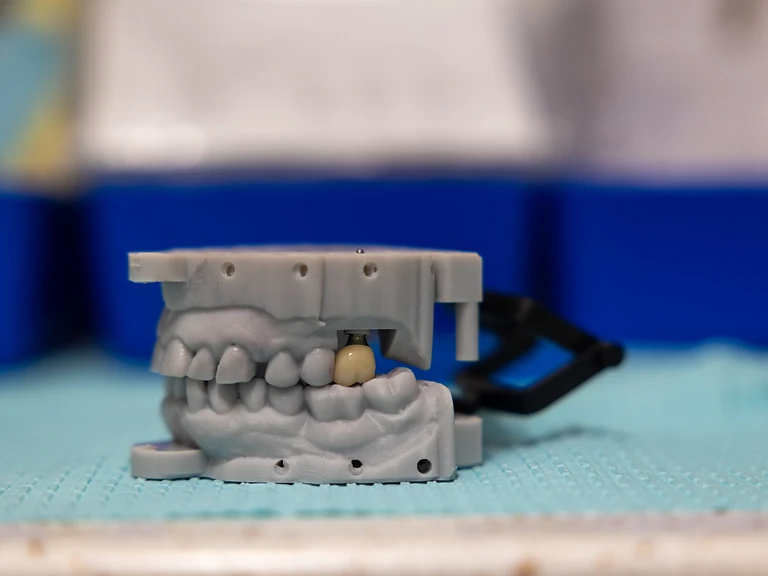
When you lose a tooth, you lose more than just what is visible above the gumline. You lose the root underneath it too. A dental implant replaces that root with a small titanium post placed in the jawbone, giving you something stable to build a new tooth on top of. That new tooth, the part you will actually see and chew with, is called the restoration.

Going deeper
What an implant actually is
An implant has three parts, often handled by two different providers. Click each layer to see what it is and who handles it.
Crown
The part you see and chew with, custom-designed to match your bite and the rest of your smile.
The short version
Five things worth knowing
If you read nothing else on this page, read these.
- 01
Three parts, not one
An implant has a post in the bone (the artificial root), an abutment that connects them, and a crown on top (the restoration).
- 02
Two providers, one team
Placement is done by a specialist. Restoration, designing and placing the crown, is what we handle here. Often we want to have the end in mind before we start, so the post can be placed where it will result in a natural-looking and functional tooth.
- 03
Like your own tooth
A replacement that looks, feels, and functions like your own, without altering the healthy teeth next to it.
- 04
We coordinate the handoff
We coordinate closely with the specialist, so the process feels seamless from your side.
- 05
Already have a post?
If you already have an implant post from previous treatment and just need the crown, we can typically help with that too.
Before you decide
It is rarely just one tooth
Patients sometimes think a single missing tooth is no big deal, especially if it is in the back and out of sight. But the teeth around it do not stay where they are. One gap can start a domino effect that changes your bite, your comfort, and the cost of fixing it later.
Teeth drift into the gap
The teeth next to the space lean and shift into it, and the tooth above or below can start to drop down with nothing to bite against.
Bone shrinks where the root was
Without a root stimulating it, the jawbone in that spot gradually thins. The longer you wait, the less bone there is to support a future implant.
Your bite changes
As teeth move out of position, the way they come together shifts too. That can make chewing harder and add strain on your jaw joints.
It gets harder to fix later
A single gap is usually straightforward to replace. A bite that has drifted often needs more work to undo before anything new can go in.
Replacing a tooth early — before the neighbors start to move — is almost always simpler, more predictable, and less expensive than rebuilding a bite that has already shifted.
Going deeper
Why an implant is different from a bridge or a denture
A missing tooth leaves a gap, and there is more than one way to fill it. Toggle between the three to see how each one works.
Dental Implant
Replaces the root itself, giving the new tooth its own independent support in the bone.
- Minimal impact on neighboring teeth — minor adjustments only, not reshaped like a bridge
- Fixed, doesn't come in and out
- Looks, feels, and functions like your own
- Helps maintain the jawbone, keeping your face looking younger
- Requires surgical placement by a specialist
- Typically takes a few months from start to finish
- Can sometimes be restored more quickly, but at greater risk — not the norm
We restore implants. We don't place them. You get a specialist's surgical expertise and our restorative care, tailored to how your bite and your smile work together.
A team approach
What the process generally looks like
Who does what, from start to finish
From the first conversation to the finished tooth, here is who handles each stage. Click a step to see the details.
Conversation & planning
We talk through your options, take a look at the tooth involved, and plan the approach together. If an implant is the right fit, we coordinate the referral to the specialist, who may also handle extraction, grafting, or other preparatory work before the post is placed.


We coordinate directly with the specialist throughout the process, so you are not left managing the handoff yourself.
After it is placed
Maintenance is part of the plan
An implant is not a set-it-and-forget-it solution. Like natural teeth, it needs consistent care to stay healthy over the long run, and the patient plays a real role in whether it succeeds.
Daily home care
Brushing and flossing around the implant every day keeps the gum and bone around it healthy. Plaque and inflammation are the top threat to a stable implant.
Regular maintenance visits
Professional cleanings and checkups at the intervals we recommend let us catch any early issues before they become bigger problems.
Watching for changes
Soreness, looseness, or bleeding around an implant is not something to wait out. The sooner we hear about it, the more we can usually do.
We will walk you through exactly what to do at home and how often to come back for maintenance, so you know what you are committing to before you start.
Who this is a good option for
An implant restoration is often a strong option for someone who has a healthy jawbone and wants a replacement tooth that functions independently, without affecting neighboring teeth. It is also frequently a piece of larger treatment plans, including full-mouth restoration and fixed implant dentures, for patients replacing several teeth at once.

What to expect
A conversation, not a sales pitch
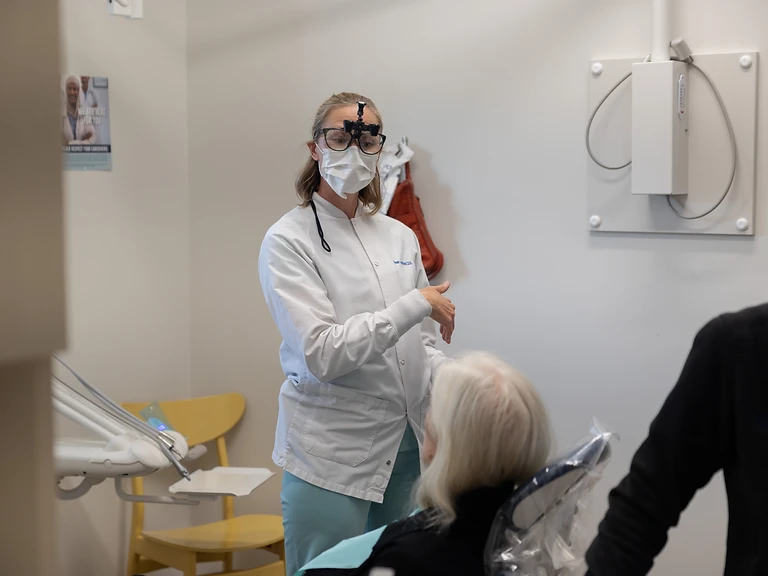
We will start with a conversation about your specific situation, take a look at the tooth or teeth involved, and talk through whether an implant restoration, a bridge, or another option makes the most sense for you.
If an implant is the right fit, we will coordinate the placement referral and walk you through what happens at each stage. More on what a first visit looks like on our new patients page.
Related pages
Dental Crowns
The crown is the part we design and place. More on how they work.
Read moreDental Bridges
The other way to fill a gap, using neighboring teeth for support.
Read moreFixed Implant Dentures
Replacing several teeth at once with implant-supported dentures.
Read moreFull-Mouth Restoration
When implant restorations are part of a larger plan.
Read moreWondering if an implant restoration is right for you?
Call or text us at 616-377-7708. We are happy to talk through your options before you commit to anything. You can also reach us through our contact page.