Replacing & Restoring Teeth
Fixed Implant Dentures
For patients missing most or all of their teeth, there is more than one way forward. A fixed implant denture is the option that stays in your mouth long-term, secured to a series of implant posts and cared for the way you would care for natural teeth.

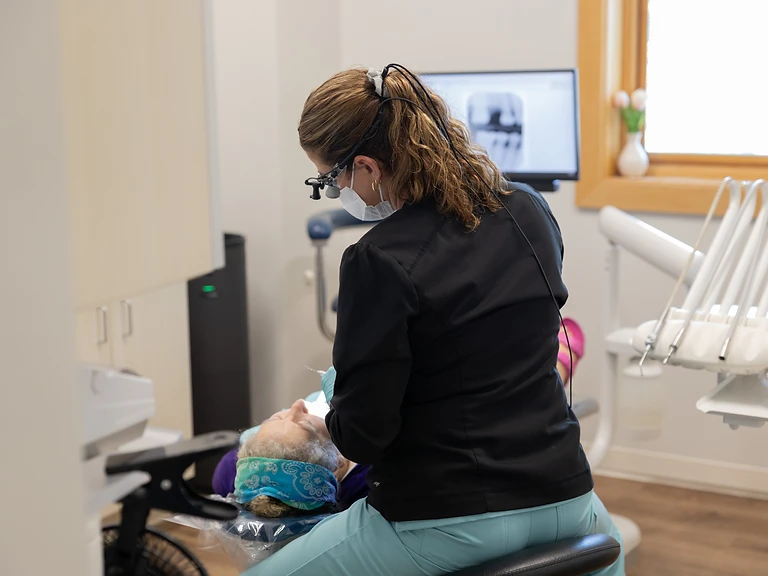
This is often a first choice for patients who still have most of their teeth but those teeth are in very bad shape. Because the work can be sequenced, you do not have to lose function in the process — you keep chewing and smiling while the transition happens.
Going deeper
How it is different from other denture options
There are a few ways to replace a full arch of missing teeth, and they sit on a spectrum. Click each option to see how it compares across what matters day to day.
Fixed Implant Denture
Secured to a series of implant posts and stays in place long-term. It is essentially one large bridge, so you care for it a bit differently than natural teeth — but it functions much the same way.
- Comes out?
- No, it stays in
- Stability
- Secured to a series of posts
- Cleaning
- Brush and floss with special technique
- Feels like
- Closest to natural teeth
The short version
Five things worth knowing
If you read nothing else on this page, read these.
Fixed in place
Secured to several implant posts and not removed by the patient, unlike a traditional denture.
Two providers, one plan
The implant posts are placed by a specialist. We handle the restoration, designing and securing the denture to the posts once they have healed.
More stability
Generally offers more stability and a bite that feels closer to natural teeth, since it does not rely on suction or adhesive against the gums.
A bigger undertaking
This is a bigger investment of time and cost than a traditional denture, and it is not the right fit for everyone. We will talk honestly about whether it makes sense for you.
Why many patients wish they had known
Most denture patients would choose this option if they had known about it or been able to afford it from the start. Younger patients facing the loss of several teeth often consider it because it tends to cost less over the long run — and because implants help maintain the jawbone that would otherwise be lost, avoiding the bone shrinkage that leaves long-time denture wearers struggling to fit even a removable denture.
Placement and restoration
Working together, seamlessly
As with any implant-based treatment, this involves at least two coordinated steps — and sometimes more. A specialist places the implant posts, and we design and secure the fixed restoration on top. Depending on your situation, extractions, grafting, or a temporary appliance may be part of the sequence too. We coordinate the whole handoff so it feels seamless on your end.
The Specialist
Places the implant posts in your jawbone. This is the surgical step that creates the foundation for everything that follows.
Langhorst Family Dentistry
Designs and secures the fixed restoration to the healed posts, custom-built to fit your bite and your smile. This is the step where the full arch comes together.
We coordinate the handoff so it feels seamless on your end, even though it involves more than one provider.
The process
What to expect, in stages
Because this treatment replaces a full arch, the process is more involved than a single crown or a traditional denture, and it happens in stages. We will walk you through a realistic timeline for your specific case before you commit to anything.
- 1
Evaluation
Thorough evaluation
We start with a comprehensive evaluation of your jawbone and overall oral health to determine whether a fixed implant denture is the right fit for you, and to plan the placement of the posts.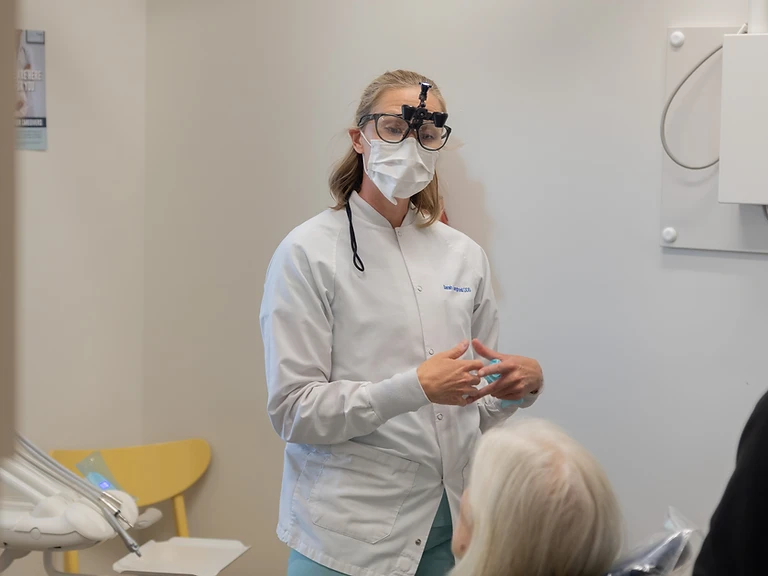
- 2
Surgery
Surgical placement
A specialist places the implant posts in your jawbone. We coordinate this step with the specialist so it feels seamless on your end, even though it involves more than one provider.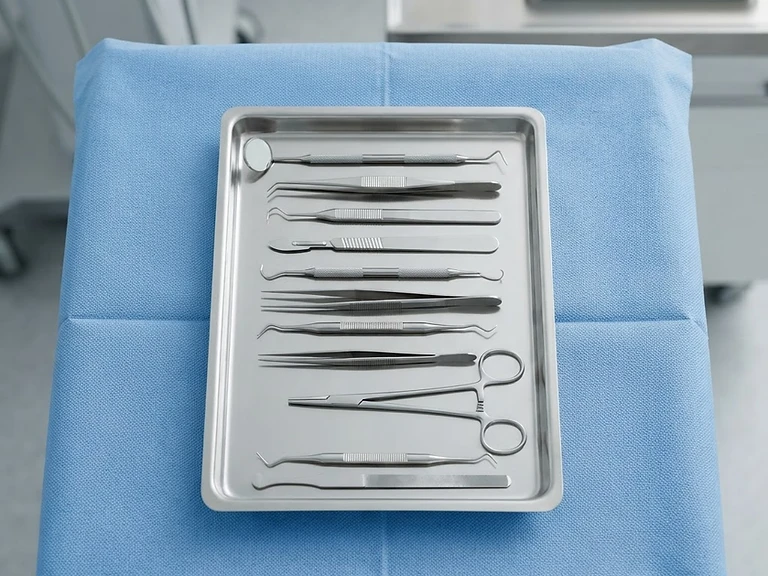
- 3
Healing
Healing and integration
The posts integrate with your jawbone over a healing period. This integration is what makes implants a stable, long-term foundation for the restoration that follows.
- 4
Trial
A temporary fixed denture to test-drive
Before the final restoration, a temporary fixed denture is secured to the posts for you to wear home. This is a trial run — a chance to live with it day to day, test the comfort and the look, and even get the honest opinion of friends and family. What we learn from how you wear it guides the design of the long-term replacement.
- 5
Restoration
Design and placement of the final restoration
Once the posts have healed and the trial has confirmed the look and feel that works for you, we design and secure your custom final restoration to the posts — built to fit your bite and your smile, informed by everything the temporary taught us. This is the step where the full arch comes together for good.


If having something removable has never appealed to you, this is worth a real conversation.
Fixed implant dentures
Caring for it at home
How you clean a fixed implant denture
Because it stays in your mouth, you care for it more like natural teeth than a removable denture — but it is essentially one large bridge, so there is a special technique for getting underneath it and around each post.
A water flosser
A water flosser with a special tip is used to flush water underneath the denture and around the implants, clearing out what a toothbrush cannot reach beneath the fixed arch.
Floss wrapped around each post
Floss is wrapped around each implant post and guided along where the post attaches to the denture, cleaning around every post individually the way you would clean between natural teeth.
We will show you the exact technique and the tools to use before you leave, so you are confident caring for it at home from day one.
Who tends to choose this option
Patients who choose a fixed implant denture are often people who have worn a traditional denture and found it uncomfortable, unstable, or simply not what they wanted long term, as well as patients who are missing most or all of their teeth and know from the start that they would rather not deal with something removable.
Many of these patients are younger than people expect, and a good number of them still have all of their own teeth. When those teeth are in very bad shape and the writing is on the wall, a fixed implant denture is often the first choice rather than a last resort. Rather than extracting everything at once and waiting with no teeth, it can be planned so the transition happens in a sequence that keeps you chewing and smiling throughout the process — you never have to go without function while the work is underway.
It is a significant decision, and we will never rush you toward it. If a traditional or implant-supported denture is genuinely the better fit for your situation, we will say so.
One honest caveat worth stating plainly: nothing in dentistry is guaranteed to be permanent. A fixed implant denture is built to be a long-term solution, but the implants, the restoration, and the bone supporting them can all change over the years. We will talk with you realistically about what to expect and how to care for it so it lasts as long as possible.

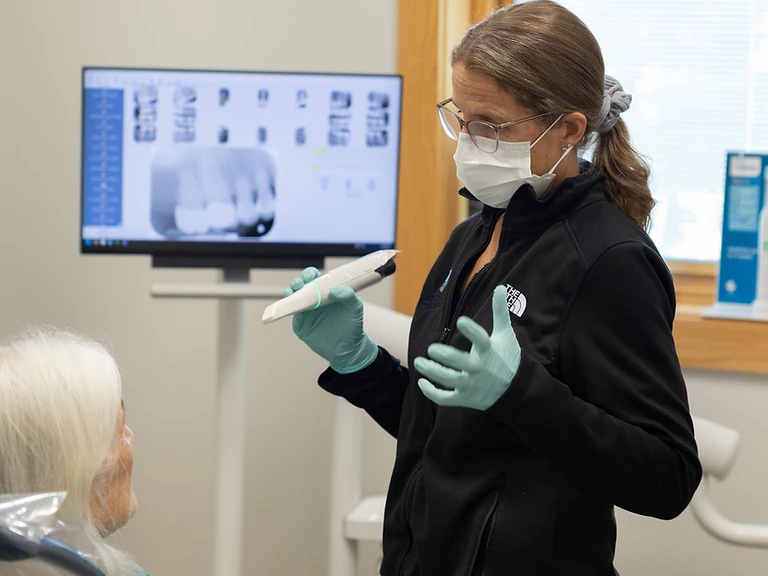
What to expect
Every option on the table
We will start with an honest conversation about your goals, take a thorough look at your jawbone and remaining teeth, and walk through every option on the spectrum, from traditional to fixed, so you can make the decision that is right for you.
More on what a first visit looks like on our new patients page.
Related pages
Implant-Supported (Snap-In) Dentures
Anchored to fewer implants, pops in and out.
Read moreConventional Dentures
The traditional, removable option.
Read moreDental Implant Restorations
Replacing individual missing teeth and roots.
Read moreFull-Mouth Restoration
A coordinated plan across the whole mouth.
Read moreCurious whether a fixed implant denture is right for you?
Call or text us at 616-377-7708. We are glad to walk through your options honestly, with no pressure to decide anything on the spot. You can also reach us through our contact page.